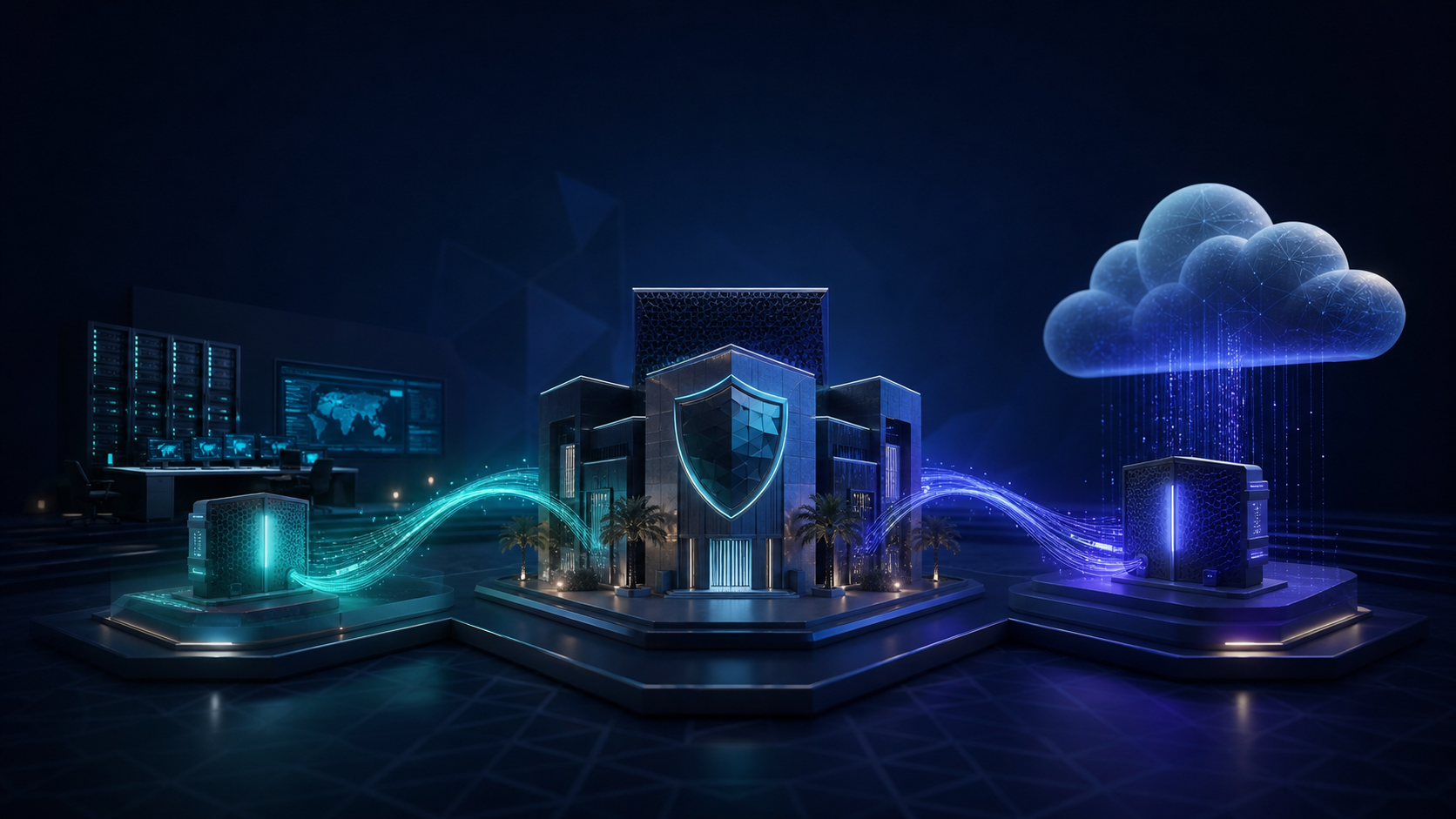
Choosing Your FortiGate Service Model: Managed Services vs. FWaaS
Managed FortiGate services or Firewall-as-a-Service? A straight comparison of both models to help Saudi enterprises pick the right operational fit for their business.
Managed FortiGate services or Firewall-as-a-Service? A straight comparison of both models to help Saudi enterprises pick the right operational fit for their business.
Buying a FortiGate firewall is a capital decision. Running it well is a strategic one — and that second part trips up far more organisations than the first. For most enterprises in the Kingdom, the real question was never whether they need a firewall. It's how they'll sustain the expert oversight that keeps one effective, month after month, year after year.
That's where the talent gap bites. Certified Fortinet engineers are hard to find and harder to keep in Saudi Arabia, which makes in-house 24/7 management an expensive, risky proposition for a lot of companies. Hire one specialist and you've created a single point of failure. Hire three and you've built a cost centre most CFOs will question. So the decision usually comes down to your operating model, not your hardware.
As a Fortinet partner in KSA, we deliver security through two distinct architectures: Managed Firewall Services (the MSSP model) and Firewall-as-a-Service (FWaaS). Neither is "better." They solve different problems. Here's how to match them to yours.
Model 1: Managed FortiGate Services (the MSSP model)
This model suits organisations that need full ownership and dedicated hardware, but would rather hand the day-to-day operational load to specialists than build that capability internally.
You keep the appliance. You keep the control. What you offload is the grind — configuration, tuning, patching, monitoring, incident response. The firewall sits in your data centre, under your ownership, but a team of certified engineers runs it around the clock so your internal people don't have to become Fortinet experts overnight.
What that looks like in practice: when a critical FortiOS vulnerability drops on a Thursday evening, someone is already testing and applying the patch rather than waiting for your engineer to notice the advisory on Sunday. When a policy needs changing for a new application rollout, it gets made properly and documented, rather than added as a quick "temporary" rule that lives forever. When an IPS signature starts throwing false positives against a business-critical app, someone tunes it instead of switching the whole profile to monitor mode to stop the complaints.
Who it fits: businesses with on-premise data centres, complex industrial or OT environments, or regulatory requirements that specifically mandate dedicated hardware. If an auditor or a framework requires you to own the box, this is your lane. It also fits organisations with heavy internal traffic and segmentation needs, where the firewall isn't just a perimeter device but the core of a segmented architecture.
Model 2: Firewall-as-a-Service (the FWaaS model)
FWaaS takes a cloud-native path. There's no appliance to rack, maintain, or eventually replace. Firewalling is delivered from the cloud and scales up or down as you need it — which is exactly what a fast-moving, distributed business wants.
This model was built for the agile Saudi enterprise that cares more about scalability and clean remote access than about owning physical hardware. Open a new branch, absorb a wave of remote workers, expand into another city — the firewall capacity follows without a procurement cycle and a shipping delay. The commercial shape changes too: you're moving from a capital purchase with a refresh cycle to an operating expense that flexes with your actual usage.
There's an architectural benefit that gets overlooked. With FWaaS, you're not sizing hardware for a peak load you might hit in year three. The capacity is elastic, so the classic sizing dilemma — undersize and bottleneck, oversize and waste — largely disappears. For businesses whose growth is genuinely unpredictable, that's worth real money.
Who it fits: cloud-first businesses, organisations with a large remote workforce, and retail or service chains growing quickly across multiple locations.
It's a fit question, not a quality question
The mistake is framing this as "which one is stronger." That's the wrong axis. A dedicated appliance in a manufacturing plant and a cloud-delivered firewall for a distributed retail chain are both correct answers — to different questions. What matters is architectural fit: where your applications live, where your people work, and what your regulators require.
Ask yourself three things. Where does the majority of your traffic actually terminate — a data centre you own, or SaaS platforms in the cloud? Do any of your compliance obligations specify dedicated infrastructure or data residency in a way that constrains the choice? And how fast is your footprint changing? The answers usually point clearly to one model.
We're positioned in the Kingdom to design, deploy, and manage both models at scale, which means we don't have a reason to push you toward one. Some clients even run a hybrid — a managed appliance anchoring the data centre while FWaaS covers cloud workloads and remote users. That's often the honest answer for organisations mid-transition: the legacy estate isn't going anywhere yet, but the new growth is all cloud.
What we bring as your partner
Consultative architecture. We don't just sell licences. We audit your traffic patterns and compliance needs, then recommend the model that gives you the best return — even when that's the less expensive one.
Saudi-based support. Our engineers know the local regulatory landscape (NCA, SAMA, PDPL) and support you in both Arabic and English. [1][2] When something breaks at an awkward hour, you're not explaining your environment to someone in another time zone reading from a script.
Lifecycle management. From the first sizing conversation through 24/7 incident response, we make sure your firewall — cloud or on-premise — behaves like a proactive shield rather than a box that quietly stopped protecting anything six months after go-live.
Frequently asked questions
Can we switch models later? Yes, and many organisations do as their architecture shifts. A managed appliance estate can migrate toward FWaaS as workloads move to the cloud. Plan the transition rather than forcing it, and time it around hardware refresh cycles where possible.
Does FWaaS meet Saudi compliance requirements? In most cases, yes — but it depends on your sector and on data residency requirements. Some regulated entities have obligations that push toward dedicated infrastructure. This is exactly the question to settle before choosing, not after.
Is managed FortiGate just outsourced IT? No. It's specialist security operations. A generalist IT provider can keep a firewall online; a Fortinet-certified team keeps it tuned, patched, segmented, and audit-ready — which is a different discipline entirely.
What if we already own FortiGate hardware? Then the managed model likely fits without any new capital spend. We take over operations on the appliances you already have, starting with an assessment of how they're currently configured.
Don't let your security posture be capped by your internal bandwidth. Whether you need a managed appliance in your data centre or a scalable cloud-native firewall, we've got the expertise to stand it up and keep it sharp.
Book a strategic consultation. Call 920-020-750, email [email protected], or visit itbuilders.com.sa.
Sources & references
Turn this insight into a practical next step.
Discuss your environment with our team and get a clear recommendation grounded in your operational reality.