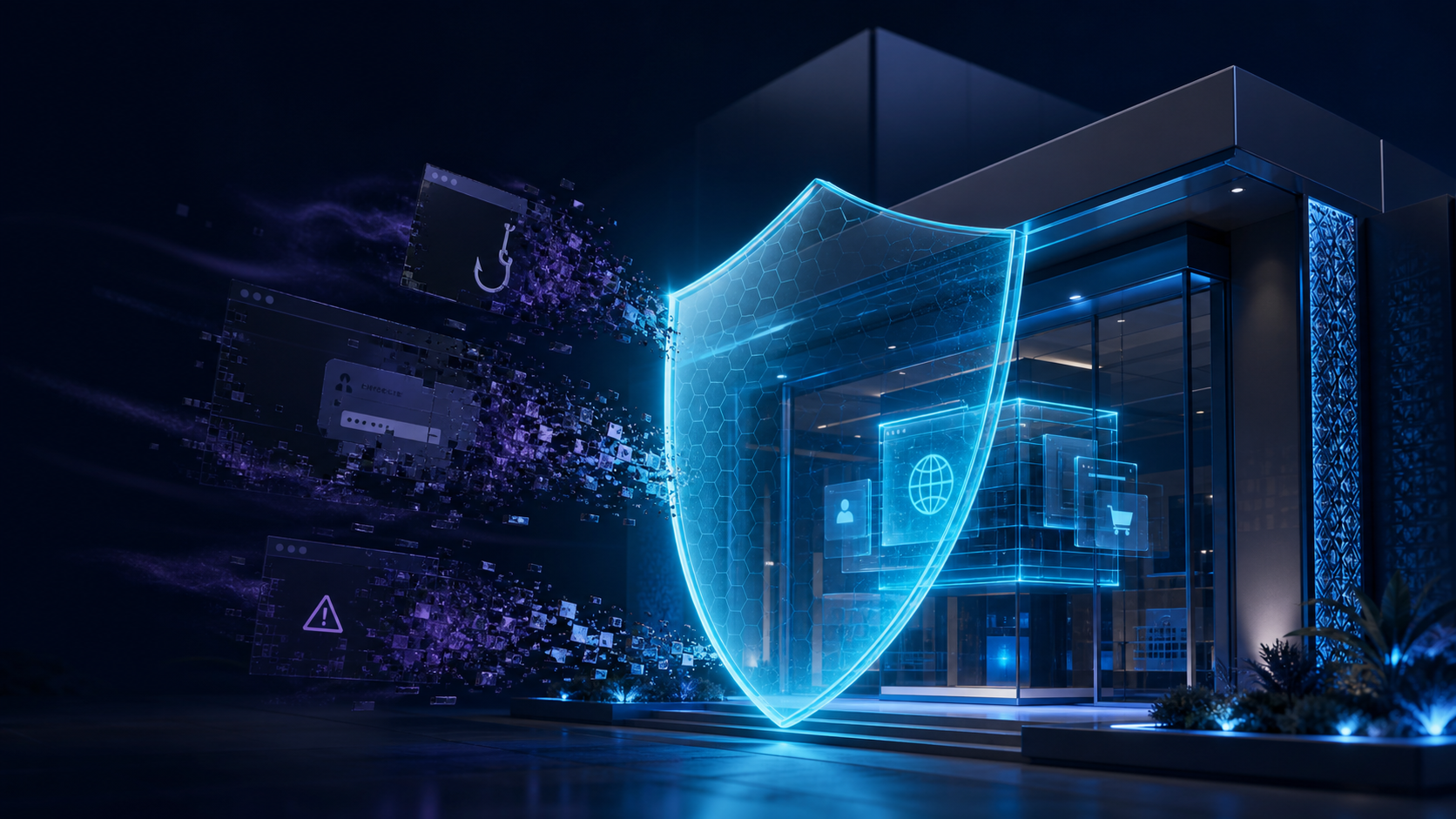
Defending the Digital Front Door: Web Application Security and Brand Protection for Saudi Enterprises
Your web applications are your most visible asset and your most exposed. Why Saudi enterprises need WAF security and brand protection to defend the digital front door.
Your web applications are your most visible asset and your most exposed. Why Saudi enterprises need WAF security and brand protection to defend the digital front door.
As Saudi Arabia moves toward a digital-first economy under Vision 2030, the web has become the public face of nearly every business. A government portal, a fintech app built in Riyadh, an e-commerce platform shipping across the Kingdom from Jeddah — these web applications are your most visible assets. They're also your most exposed.
Web application attacks have grown sharply across the Middle East as digital services have multiplied, and the reason is simple: attackers follow the value, and increasingly the value sits in the application layer rather than behind the network perimeter. For a Saudi organisation, a compromised website isn't a tidy technical footnote. It means leaked customer data, real financial loss, and a brand reputation that takes years to rebuild — if it recovers at all. When an attacker can knock a portal offline with a single DDoS burst or siphon data through a hidden SQL injection, a traditional network firewall stops being enough. You need specialised WAF protection and proactive brand defence.
What a WAF is, and why your network firewall isn't one
IT managers ask a reasonable question all the time: "I already have a network firewall — why do I need a WAF?"
Think of it this way. A network firewall is the security guard at the building's main entrance, checking who's allowed in the door. A Web Application Firewall is the inspector who opens each package being delivered to your web server and checks what's actually inside it. The network firewall looks at where traffic comes from. A WAF looks at what the traffic is trying to do.
That difference is everything, because application-layer attacks arrive looking perfectly legitimate — right port, valid session, clean origin — and sail straight past a control that only checks the envelope. An SQL injection payload arrives over HTTPS on port 443, the same port your firewall is configured to allow. A cross-site scripting attack comes through a form field your own developers built to accept user input. A broken access control flaw is exploited by a genuinely authenticated user making a request the application was never designed to permit. None of these are network-layer threats, so none of them trigger a network-layer control.
A WAF is purpose-built to stop the OWASP Top 10 — the industry's definitive list of the web application risks behind most breaches worldwide. [1] It inspects HTTP and HTTPS traffic in both directions, applies rules for known attack patterns, and enforces a positive security model that blocks anything straying from how your application is supposed to behave.
The threat to your reputation: brand protection
In the Saudi market, trust is the whole currency. And cybercriminals have figured out that they don't need to breach you to hurt you — they can go after your customers directly through brand impersonation.
They spin up fake websites that mirror yours almost exactly, a trick called typosquatting, or stand up counterfeit social media accounts to harvest login credentials from people who think they're dealing with your brand. The damage lands on you regardless. Your customer loses money, your brand takes the blame, and you find out when the complaints start arriving.
Brand protection is the proactive work of scanning the wider internet — including the dark web — to find these impersonators before your customers stumble into them. We use AI-driven tools to locate and take down malicious lookalike sites, ideally before a single customer gets caught. It's a fundamentally different discipline from securing your own infrastructure: the threat isn't inside your perimeter at all, which is exactly why traditional security tooling never sees it.
Web security goes past the website itself
Web security isn't only about your public site. It's also about how your employees interact with the internet every day — the links they click, the domains they resolve, the traffic leaving your network.
DNS-layer defence matters here, because a great deal of trouble starts with an internal user reaching somewhere they shouldn't rather than an external attacker banging on the front door. Blocking malicious domains at the DNS layer stops phishing and malware callbacks before a connection is ever established. Secure web gateways add inspection and policy on top, controlling what leaves your network and catching threats in the traffic your people generate themselves.
Aligning with NCA and SAMA
For organisations in financial services, healthcare, or government, web security isn't a nice-to-have. It's a regulatory requirement. The NCA's Essential Cybersecurity Controls address web application protection directly, and organisations operating critical systems face more prescriptive requirements still. [2] SAMA's framework covers application security for regulated financial entities.
Our web security services keep you secure and compliant at the same time, generating the automated reports and audit trails that inspectors expect to see. When the audit comes, you have the evidence ready instead of scrambling to produce it — which is usually the difference between a clean assessment and a finding.
The ITBuilders edge: Fortinet SecOps and EPSP
Protecting a web application takes more than switching a WAF on. It needs constant tuning and expert monitoring, so legitimate users don't get blocked while real attacks get stopped — the balance that untuned WAFs almost always get wrong.
This is worth being blunt about, because it's the most common WAF failure we see. An untuned WAF in blocking mode drowns the team in false positives, so it gets flipped back to detection mode to stop the disruption — and at that point it's logging attacks rather than stopping them. A tuned WAF, profiled against your actual application traffic, runs quietly and blocks real attacks while leaving your users alone.
As a Fortinet Engage Preferred Services Partner (EPSP), we have a direct line to some of the most advanced security intelligence available, and we lean on the Fortinet Security Operations Specialization to run your web defences through our Saudi-based SOC. That combination — the credential plus the local operations centre — is what keeps a WAF effective month after month rather than just switched on at install.
Frequently asked questions
Do we need a WAF if we already have a network firewall? Yes. They operate at different layers and stop different things. A network firewall checks where traffic comes from; a WAF checks what it's trying to do. Application-layer attacks pass straight through network firewalls by design.
Will a WAF slow down our website? A properly tuned one, no. Poorly configured WAFs can add latency or block legitimate users — which is why tuning and ongoing management matter far more than the appliance choice.
What is typosquatting? Registering domains that closely resemble yours — a swapped letter, a different extension — to build convincing fake sites that harvest your customers' credentials. Brand protection scans for and takes down these lookalikes.
Is a cloud WAF or an on-premise WAF better? It depends on where your applications are hosted. Cloud-hosted applications generally suit a cloud or CDN-integrated WAF; on-premise applications often suit an appliance. Many organisations run both.
Securing your digital legacy
Your website is a critical business engine, not a brochure. If that engine gets hijacked, the fallout is legal, financial, and reputational all at once. To compete in the Kingdom's digital economy, you need a partner who can see the threats you can't — and act on them before your customers feel the impact.
We offer a comprehensive Web Application Vulnerability Scan. We'll test your site for the most common weaknesses and give you a detailed report on exactly how a WAF closes those gaps.
Book your Web Security Review. Call 920-020-750, email [email protected], or visit itbuilders.com.sa.
Sources & references
Turn this insight into a practical next step.
Discuss your environment with our team and get a clear recommendation grounded in your operational reality.