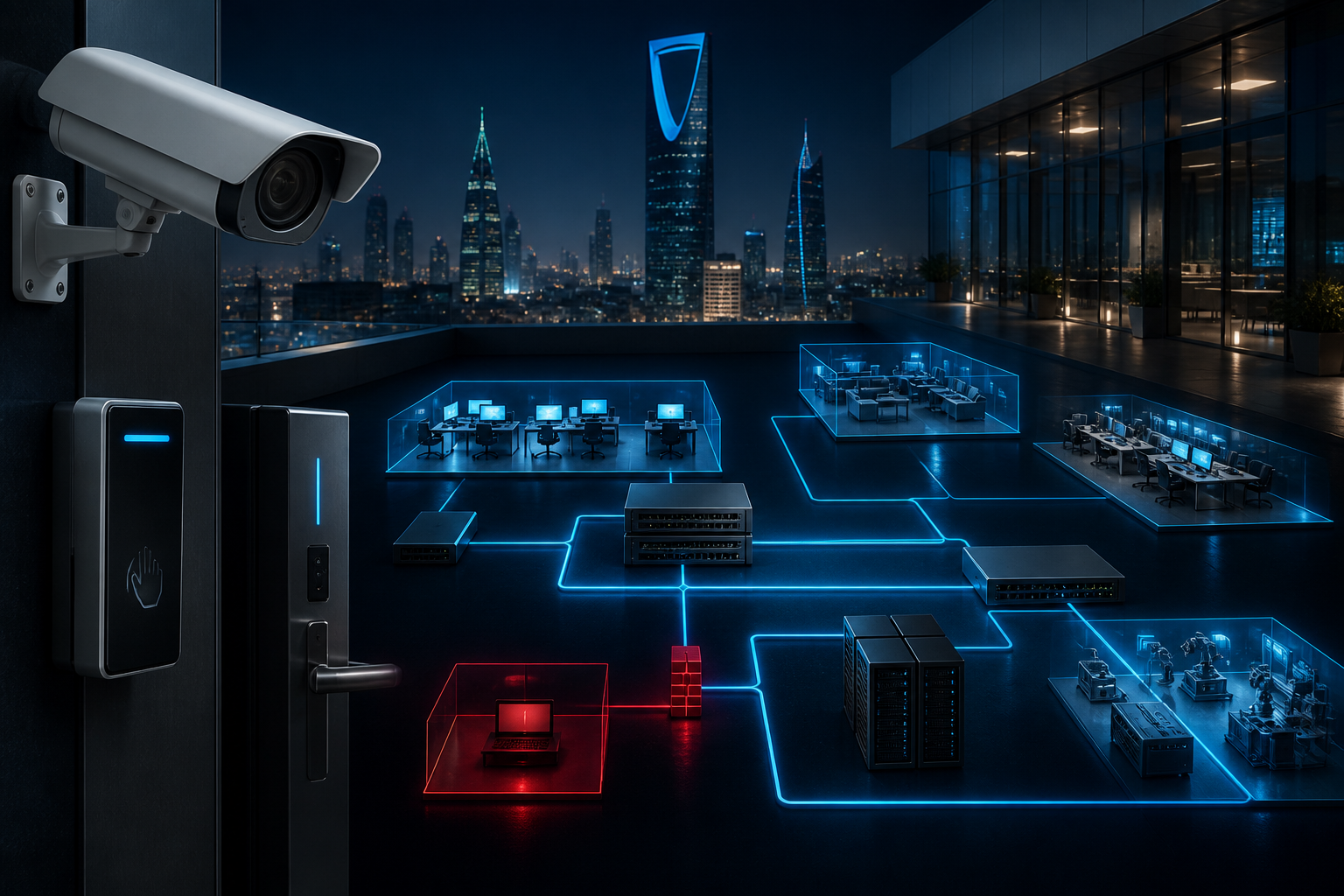
Converging Physical Security and Network Security: Cameras, Readers, and Controllers as Network Endpoints
Cameras, readers, and controllers are network endpoints. How Saudi organisations should segment, govern, and monitor physical security infrastructure.
Cameras, readers, and controllers are network endpoints. How Saudi organisations should segment, govern, and monitor physical security infrastructure.
Physical security systems stopped being isolated more than a decade ago. Surveillance cameras hold their own IP addresses. Access control readers report to networked controllers. Building management systems, intercoms, and gate barriers push data across the same infrastructure that carries email and enterprise applications.
Ownership rarely followed. In most organisations, facilities teams still procure and operate these systems, while network and security teams never see the devices at all. The result is a class of connected endpoint that receives none of the controls applied to every other endpoint on the network.
This article works through the control domains that close that gap: network placement, credential and identity management, device lifecycle, footage and record governance, and the integration of physical access events into security monitoring.
Why the exposure is structural rather than incidental
Three characteristics separate physical security devices from conventional IT endpoints, and each one compounds the risk.
They run embedded software with long service lives. A camera or controller may stay in service for a decade, well past the period during which its firmware receives active support. Replacement rarely gets driven by software support status, because facilities teams evaluate the device on whether it still produces an image or still opens a door.
They ship with predictable default configurations. Manufacturers supply devices with known default credentials and administrative interfaces enabled. Installers commission dozens or hundreds of units under time pressure. Hardening steps that require per-device attention get skipped at scale.
They sit at the network edge in physically accessible locations. A camera mounted in a car park, a reader beside an external door, and a controller in an unlocked riser cupboard all present physical access to a live network port. That is a fundamentally different exposure from a workstation inside a controlled floor.
Taken together, these characteristics produce a population of long-lived, weakly hardened, physically reachable network devices that most security teams have never inventoried.
Control domain: network placement and segmentation
Segmentation is the single highest-value control in this domain, and it is the one most frequently absent.
Physical security devices should occupy a dedicated network segment with no routed path to general corporate resources. Cameras need to reach their recording platform. Readers need to reach their controller. Neither needs to reach a file server, a finance application, or the internet. Access control lists should express that narrow requirement explicitly rather than permitting broad traffic and filtering exceptions afterwards.
Port-level controls matter as much as segment design. Network access control enforced at the switch port prevents an attacker who unplugs an external camera from gaining an unauthenticated foothold through the cable it leaves behind. Where certificate-based device authentication is impractical on older equipment, MAC-based authentication with port security limits still raise the effort required considerably.
Management interfaces need separate treatment again. Administrative access to recording platforms and access control servers should traverse a management network reachable only from defined administrative hosts, never from the general user population and never from the device segment itself.
Outbound traffic deserves scrutiny. Many devices attempt connections to manufacturer services for updates, time synchronisation, or remote support. Each of those connections is an egress path out of a segment that should have almost none. Policy should permit only the destinations the organisation has deliberately approved.
Control domain: credentials and administrative access
Default credentials remain the most exploited weakness in surveillance estates, and the reason is procedural rather than technical. Commissioning happens once, at scale, under schedule pressure, and no subsequent process revisits it.
Every device requires a unique administrative credential recorded in the organisation's privileged access management system rather than in an installer's spreadsheet. Shared credentials across a camera estate mean that compromise of one device compromises all of them.
Administrative accounts on recording and access control platforms should authenticate against the enterprise directory wherever the platform supports it. Local accounts that survive outside identity governance escape the joiner, mover, and leaver process entirely, which is how departed contractors retain access to live camera feeds long after their engagement ends.
Role separation belongs in these platforms as well. Viewing live footage, exporting recorded footage, modifying retention settings, and granting access rights are distinct privileges with distinct risk profiles. Platforms that collapse them into a single administrator role make meaningful access governance impossible.
Control domain: device lifecycle and firmware
Firmware management for physical security devices needs the same discipline applied to servers, adapted to the constraints of the equipment.
An accurate inventory comes first, and most organisations discover on building one that the estate contains devices nobody could account for. The inventory should record model, firmware version, physical location, network segment, and support status.
Support status drives replacement planning. A device whose manufacturer no longer issues firmware updates carries permanent, unpatchable risk. That fact belongs in the capital planning cycle, alongside the physical condition of the unit. Facilities teams cannot make that judgement without input from the security function.
Update testing matters because these devices sit in critical paths. A failed camera firmware update leaves a blind spot. A failed controller update can leave doors in an undefined state. Staged rollout across a representative sample precedes estate-wide deployment.
Decommissioning closes the loop. Devices removed from service retain configuration data, credentials, and sometimes recorded footage. Secure disposal procedures should treat them as data-bearing assets, because that is what they are.
Control domain: footage, records, and data governance
Surveillance footage and access logs are personal data. They identify individuals, record their movements, and reveal patterns of behaviour. Saudi organisations handling this data carry obligations that extend well beyond the security function.
Retention periods need definition and enforcement. Indefinite retention creates a growing archive of personal data with no defined purpose, and defending it under regulatory scrutiny becomes progressively harder. The period should reflect a documented operational requirement.
Access to recorded footage should be logged, reviewable, and justified. Who viewed which camera, when, and for what stated reason are questions the organisation should be able to answer. Export of footage to removable media or external recipients demands stricter control still, because it moves personal data outside the system boundary entirely.
Placement of cameras carries its own governance weight. Coverage of areas where individuals hold a reasonable expectation of privacy requires a documented justification, and in many cases signage and notification obligations apply.
Access control records deserve equivalent treatment. Badge event data reveals attendance patterns, working hours, and movement histories. Its use for purposes beyond security, such as performance monitoring, should be a deliberate, documented decision rather than an informal practice that emerges over time.
Control domain: monitoring integration
Physical access events carry security value that most organisations never extract, because the two systems never share data.
Correlation produces the value. A badge event placing a user at a Riyadh office while their account authenticates from another country is a signal neither system generates alone. A door held open outside working hours in a server room, coinciding with a configuration change, tells a story that neither the access log nor the change record tells independently.
Feeding physical access events into the same monitoring platform that receives network and endpoint telemetry makes those correlations possible. The integration requires the access control platform to export events in a consumable format, and it requires monitoring rules written specifically for the physical dimension.
Device health telemetry belongs in the same pipeline. A camera that stops reporting, a controller that reboots unexpectedly, or a reader that goes offline are operational events with potential security meaning. Treating them as facilities maintenance issues alone discards that signal.
The governance question underneath all of it
Every control domain above depends on a prior decision about ownership, and organisations that skip that decision implement none of them consistently.
Physical security infrastructure needs a defined owner for its network configuration, a defined owner for its device lifecycle, and a defined owner for the personal data it generates. Those three responsibilities may sit with different functions, but each requires a name against it. Where facilities procures and operates the systems while IT security carries the risk, the gap between authority and accountability guarantees that hardening never happens.
The practical fix is procedural. Physical security equipment should enter the same procurement review, the same architecture review, and the same asset register as any other connected technology. Not because facilities teams lack competence, but because these devices are network infrastructure, and network infrastructure belongs in the network governance process.
Frequently asked questions
Does segmentation alone resolve the exposure? No, though it addresses the largest share of it. Segmentation limits what a compromised device can reach. It does not prevent the compromise, protect the recorded data, or address governance of the personal information the system holds.
Should physical security systems connect to the corporate network at all? They already do in nearly every organisation, and full physical separation is rarely economic at scale. The realistic objective is a logically isolated segment with tightly defined permitted paths, not an air gap.
How should an organisation begin if it has no inventory today? Discovery precedes everything. A network scan across the segments where these devices sit produces the initial picture, which physical verification then corrects. Most organisations find devices they did not know existed, and the inventory itself often justifies the remediation budget.
Who should own the risk? The security function should own the risk and the standards. Facilities can continue to operate the systems day to day, provided the configuration standards, lifecycle policy, and data governance rules come from the function accountable for the outcome.
How ITBuilders supports physical security convergence
ITBuilders designs and delivers physical security infrastructure alongside enterprise networking and cybersecurity, which allows both dimensions to be addressed under one architecture rather than in separate projects. Engagements cover surveillance and access control design, network segmentation for security estates, integration of physical access events into monitoring, and the governance documentation the systems require.
To discuss physical security architecture, contact ITBuilders at 920-020-750 or itbuilders.com.sa
Related services
Physical Security · Networking & SD-WAN · Cybersecurity Services
Turn this insight into a practical next step.
Discuss your environment with our team and get a clear recommendation grounded in your operational reality.
Related intelligence

Partner Evaluation Checklist: What to Look for in a Certified Fortinet Partner Before Deployment
Demystifying Fortinet Licensing: Enterprise Protection vs. Unified Threat Protection (UTP) vs. Advanced Threat Protection (ATP)